Sunday, 20 February 2022

The Mini PET 40/80

Introducing the Mini PET 40/80.

This is an improved version of the original Mini PET, and includes all of the optional features of that kit, the colourful deluxe keyboard and perspex baseplate and clear top panel.

The kit is still based on all modern through hole parts. The heart of which is the WDC W65C02S CPU. It is compatible with most software for the Commodore PET from the 2001 series through to the 8032. 32K RAM is provided as standard, the maximum the PET can support (without going into paged RAM). It does not have a 6545 CRTC, so some graphical demos will not run, but pretty much everything else will.

This side hasn't changed much, address decoding, IO and CPU. I swapped out a 74HC10 that used to be there for another 74HC138. It does the same job, but is one fewer part on the BOM.

This section doesn't look very different, but lots of work has gone on here. The video RAM is now 2K bytes, and supports 40 or 80 character modes, with a 74HC257 being used to select the dot clock. Gone is the 74HC74, with the character inversion now hard coded inside the character ROM. There are more DIP switches, as there are more video mode options. 

For a 40 column display, the CRTC microcontroller has 16 clock cycles to read the character code from the video RAM, looking that up in the font ROM to get a bit pattern and load that into the shift register. For an 80 column display, that is only 8 clock cycles, so the firmware had to be completely rewritten to achieve that. It is now using only 6 cycles per character to allow loops to be used rather than the previously unrolled loop code.

This section is mostly new. Some old school 4000 series logic running at 9V providing soft power on/off, and also controlling the 40/80 column selection. The new style 8 pin regulators replace the 7805 and TIP29s. Sad to seem them go, but would have needed additional MOSFETs to switch those off during standby. The two red LEDs show when the motor power is activated on the two datasette ports.

The Mini PET 40/80 is wider than the previous Mini PET, adding a second datasette connector to the rear. That allows you to use an SD2PET SD card disk drive and a datasette drive without having to unplug anything.

There are more video modes, monochrome composite video in PAL and NTSC, support for 9" or 12" PET monitors and a new 9 way D monitor connector to the side for RGBI/CGA/MDA monitors. I have been surprised that I have not been asked more often if that is VGA. It is not, that would have needed a second crystal oscillator and a faster microcontroller to deal with the line and frame rates required for VGA. Power is from a 9V DC centre negative supply (included in the kit).

There are now four function keys down the side of the keyboard (I wonder where I got that idea from - maybe I should make them orange or grey?). Soft power on / off controls the new power circuitry, the reset button and NMI Menu button are now full size keys and there is a new 40/80 button which changes video mode, changes the ROM set and resets the Mini PET so you can easily switch between 40 and 80 column systems.

The Mini PET 40/80 has it's own version of BASIC, Mini PET BASIC 4.1, adapted from Commodore BASIC 4.0 with a few extra commands, and built in features including a file browser, a full self test and a DOS Wedge which is permanently active (no need for a SYS call or to load from disk). 

The self test can be started from any of the versions of BASIC, or selected via the DIP switches. This will cycle continuously to act as a burn in test.

Pressing the Menu button brings up the built in file browser to allow you to load files more quickly from an SD2PET or other disk drive.

The big change is the 80 column mode. Great for text adventures, programming and business software. Seen here with the optional 2 pixel gap between lines enabled.

The extra space makes text heavy screens easier to read.

But of course, 40 column mode is still the default, ready for all the usual games.

Or new ones

Attack of the PETSCII Robots - The best game ever written for the Commodore PET [citation needed]

Or there are my own PET remakes of Tut-Tut

and 3D Monster Maze

And with 80 column mode, you can use the cheat mode in 3D Monster Maze to get a Pterodactyl's eye view of the maze.

See how the maze is drawn and how Rex moves and even find the exit.

Or fully show off the 80 column mode with Cheese and Chive. 

The best game ever written for the 80 column PET.

The Mini PET 40/80 is a self assembly kit, not for the novice, some soldering experience is necessary.

To help you along with the process, the kit comes with a lovely spiral bound manual

Being spiral bound is idea so you can lay it flat on the bench as you are working.

The Mini PET 40/80 kits are available now from The Future Was 8 bit 

I don't know at this stage if this will follow the Minstrel kits in being the Final Edition. We are will waiting for IC availability will return to previous levels. When I will see this many microcontrollers again?

So if you want one, get yourself along to the The Future Was 8 bit now 

Also available: The Mini PET 40/80D.

Read more about that here: http://blog.tynemouthsoftware.co.uk/2022/03/the-mini-pet-4080d.html


2026 Update

All the kits at TFW8b have now sold out, and the Mini PET II is on the way, but various versions are still available from my Tindie store. 


Patreon

You can support me via Patreon, and get access to advance previews of blog posts, and progress updates on new projects like the Mini PET II and Mini VIC and other behind the scenes updates. This also includes access to my Patreon only Discord server for even more regular updates.

Tuesday, 8 February 2022

The Blog Returns

I am slowly bringing the old blog posts back online.

Each post will have a message at the top explaining its status.

This is an old post, preserved for reference.
The products and services mentioned within are no longer available.

With the exception of the items listed below, I am no longer able to supply the products these blog posts describe and promote. Component availability and shipping problems mean it is no longer possible to get the parts required, or post the items out worldwide, I would ask that you accept that and refrain from requesting anything not listed here.

Some items available via the Tynemouth store at the Future Was 8 bit:

"Final Edition" Vintage Computer kits - whilst stocks last!

Pre-assembled products
  • Mini PET 40/80D - (NEW) Replacement mainboard for Commodore PETs, supports 40 and 80 column mode, normal and business keyboards. Built in SD2PET SD card drive
  • PET ROM/RAM - Replacement ROM and RAM for Commodore PETs
  • SD2PET - IEEE-488 SD card drive for Commodore PETs
  • VIC 20 Penultimate Cartridge+ - Menu driven RAM and ROM cartridge for the VIC 20
Games on tape
  • 3D Monster Maze - The best game for the ZX81 remade for the Commodore PET / Mini PET
  • Tut-Tut - PET / Mini PET version of David Stephenson's excellent ZX Spectrum game
Digital downloads of the games are available via my Itch.io store
Anything not listed above is unfortunately no longer available. And no, I don't have just one left that I could sell you. And yes, I have checked down the back of the sofa. TFW8b support cannot help with any of my other products, only the ones they currently sell, so please do not ask.

Whilst the blog has been offline, I have been posting via my Patreon. I will start to bring some of the older posts from there onto here once I have finished working through the existing blog posts.

The new posts will be highlights of the posts on Patreon. I will continue to provide early access to the new posts and exclusive behind the scenes development blogs and updates on the Patreon. 

You can follow along on there if you like. 

https://www.patreon.com/tynemouthsoftware

Update: Most of the posts are back online now. I have decided not to bring back any of the USB keyboard posts, as they create too many enquires.

Sunday, 1 November 2020

Mini PET Perspex Case

This is an old post, preserved for reference.
The products and services mentioned within are no longer available.

We have updated the Mini PET kit options to include a Perspex case kit.
As soon as the Mini PET was launched, people started asking about cases. There were lots of people saying they would like one, and lots of people saying they were going to design a 3D printed one. I sent out dimension drawings and 3D models to various people, although I had to graciously decline the offers of 'send me a free kit and I'll design you a case'.
This one has been designed by Mr RC2014, and is available from his Tindie store, and now also as an option when ordering a Mini PET kit from the Future Was 8 bit (https://www.thefuturewas8bit.com/shop/tynemouth-products.html).
The kit includes two laser cut pieces of Perspex and a fixings kit. 
There is a blue baseplate which screws to the pillars on the bottom of the Mini PET mainboard and keyboard. Note this is not symmetrical as the keyboard includes mounting holes to match the original PET keyboard were the top row of holes was not symmetrical. Make sure all the holes are lined up before you start putting in all the screws.
The 10mm pillars sit between the main PCBs and the base plate. There are 8mm pillars to go between the main PCB and the keyboard overlay PCB, and 10mm pillars between the main PCB and the top plate.
The fixings kit is used in addition to the fixings supplied with the Mini PET mainboard and the keyboard kits. As well as the nylon pillars and feet, this kit also includes two tall tactile switches to replace the standard ones in the Mini PET kit, to allow them to be pressed once the top plate is in place.
The top clear plate covers the mainboard and includes holes to access those switches and the DIP switches, and also has holes to let the sound of the space invaders escape their new acrylic home.
The top plate also includes cut outs for the two taller connectors (power and video), as well as engraved legends for all the external connectors.
Mini PET kits are available from The Future Was 8 bit (https://www.thefuturewas8bit.com/shop/tynemouth-products/mini-pet.html)
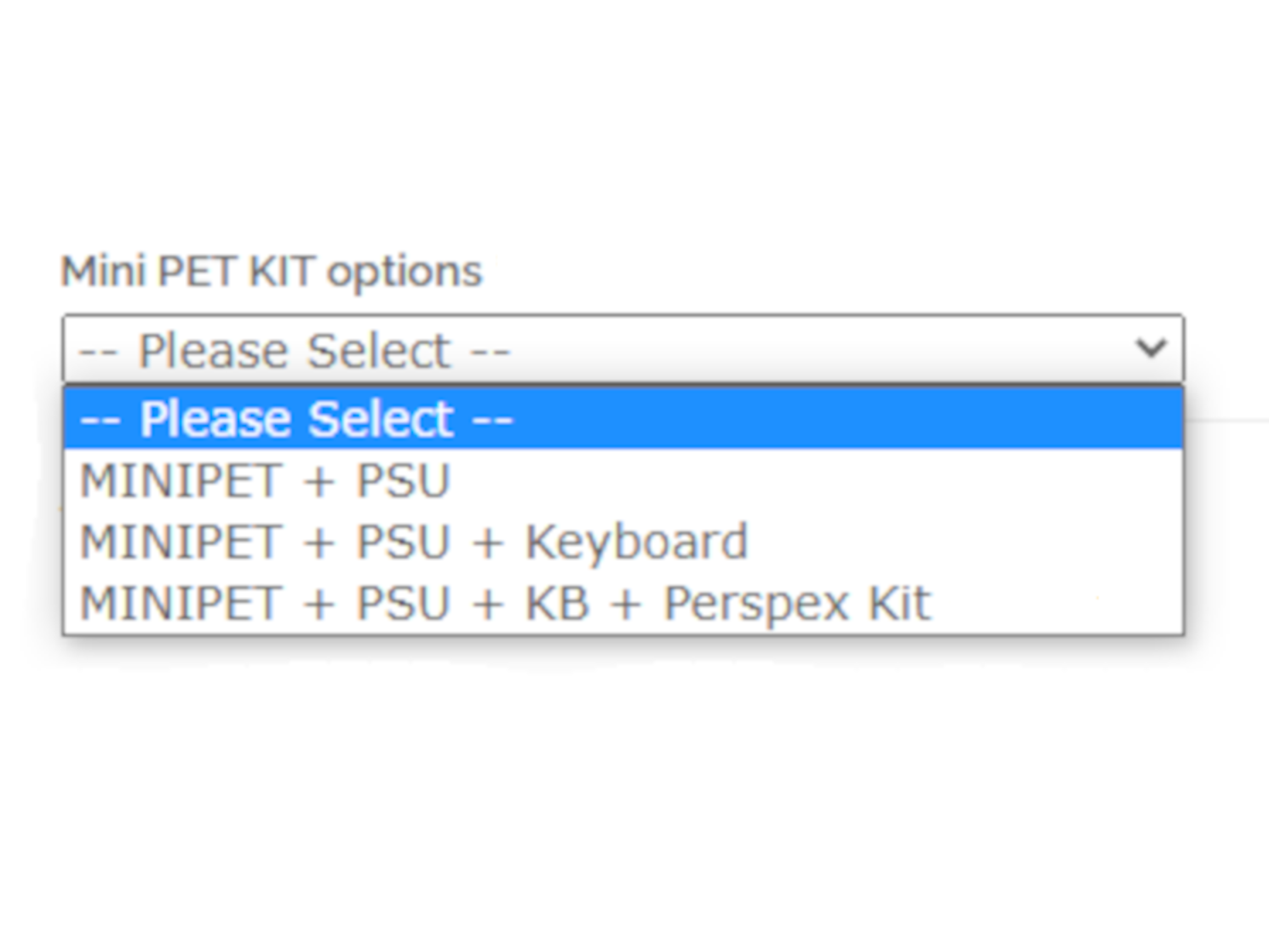
You now have a choice of the getting the Mini PET without a keyboard (if you are using an original keyboard or one of the cherry switch versions). Or you can order with the deluxe keyboard.
Or, you can order the kit with the deluxe keyboard and this Perspex case kit. (all versions now come with the TFW8b 9V power supply)
If you are replacing the mainboard in a PET, you need the internal version (Kit B). https://www.thefuturewas8bit.com/minipet-b.html
You can also get the Perspex case kits if you want to add a case to an existing Mini PET kit. Note the fixings kit supplied with those kits is different to the one included with the Mini PET kits as shown above. 
There is also a version available from there with a cutout slot at the front, which will suit all boards with the original 3+5 way DIP switches or the later ones with the single 8 way.


2022 Update: The Mini PET has been replaced by the Mini PET 40/80. This comes with the Perspex kit included, and has a built in much nicer keyboard and supports 40 and 80 column mode. Available now from The Future Was 8 bit.

Sunday, 25 October 2020

RC2014 Mini CP/M Upgrade Kit

This is an old post, preserved for reference.
The products and services mentioned within are no longer available.

I have been investigating various Z80 CP/M machines recently, this is a nice simple one to get started with. This is a two board solution the RC2014 Mini and the RC2014 Mini CP/M upgrade kit.

The traditional RC2014 is a handy modular Z80 system (other CPUs are available, but I'll stick to Z80 today). CP/M (Control Program / Monitor) is a late 1970s precursor to DOS, and ran on many of the Z80 based systems until the mid 80s when MSDOS based PCs took over the world. There is a fascinating (possibly apocryphal) story of why the IBM PC shipped with MS DOS rather CP/M, which seems to come down to the representative of the more established CP/M who didn't think it was worth their time attending a meeting with IBM, and some young guys from a tiny company that grasped the opportunity and got the contract.
This is pretty much the minimal system you would need to run CP/M, five boards and a backplane. In this case:
  1. 64K RAM board
  2. Pageable ROM board
  3. Compact flash storage
  4. 5 slot backplate
  5. Z80 CPU, clock and reset
  6. Serial card (in this case 68B50 ACIA)
(and that is using my Z80 CPU card with built in clock, if you stick to official modules, you need a sixth board to provide a clock)
The new kit starts off with the already reduced RC2014 Mini. The Mini combines the Z80 CPU, a clock, 32K of RAM, 8K of non-pageable ROM and a 68B50 serial interface.
On it's own that is a nice little Z80 system that runs BASIC via a serial terminal.
This is arranged as 8K of ROM from 0000-1FFF, and 32K of RAM from 8000-FFFF. CP/M requires RAM from address 0000 upwards, normally the full 64K where possible. The RC2014 Mini has ROM fixed at that address, so the ROM chip has to go.
Now we come onto the new board. I like the packaging, a laser cut piece of cardboard protects the IC sockets in transit.
The new board is the same shape and size as the original RC2014 Mini, and is designed to sit on top of it.
This has a second 32K of RAM, which sits at 0000-7FFF, which gives the full 64K of RAM that we need. 
The Z80 boots from address 0000, so there needs to be a way to get CP/M loaded and running, and so there is a ROM chip which can be switched into that address range at boot time.
This boots to a monitor program from which you can load code over serial direct to RAM (which is only required if you are setting up your own compact flash card from scratch). There is also a menu option to boot BASIC. That doesn't work with the supplied ROM, but you can select the BASIC only ROM with the jumpers. (The hardware should support it, but it needs a version of BASIC compiled to run at 2000 and use the 68B50 ACIA)
When the X option is selected, code is copied from the CF card into the top of RAM, then the ROM is switched off leaving just RAM and CP/M is booted.
Once booted, you have access to the CF card as a selection of 8MB disks. A: contains only a download program, and C: has a selection of utilities. You can use download to transfer your favourite programs onto these disk images.
Such as the Infocom Hitch Hiker's Guide to the Galaxy or Zork.
And there is also a version of Microsoft BASIC
So that's the RC2014 Mini CP/M upgrade kit, a nice easy way to get a minimal CP/M system up and running.

2022 Update: RC2014 continues to be very popular, they can now be ordered from the sellers new store z80kits.com