
In the last post I look at the Sony TCM-818, a great cassette recorders for use with 1980s computers.
One of the things I didn't like was the battery power option, since I would rather not use C cells, and using AA rechargeables in adapters is not ideal.

Battery Upgrade
My plan is to take a bit of a tatty TCM-818, I picked up recently and make it my daily driver work horse. I could use power it from the mains, but I would rather keep it battery, so I plan to replace the four C cells with something better.
The C cell voltage is between 1.2V and 1.5V, so 4.8V-6.0V for a set of four.
Checking the schematic, the main IC is an LA4162.

(I was slightly disappointed to note the erase head on the bottom left there is a magnet rather than being a proper one, but I guess it works fine and I rarely record on these)
There isn't much information on that IC, but it appears to be rated for 3-10V, so this is well in the range.

In a previous post, I harvested some 18650 cells from a laptop battery.
My plan is to use two of these in place of four C cells.

The 18650s are nominally 3.7V, but that can range from about 3.6V to 4.2V depending on the charge level. A pair of those should give me between 7.2V to 8.4V.
That is maybe a little high, so I was thinking of various ways to reduce the voltage a bit. My first thought was a couple of 1N4001 diodes, these have approximately 0.6V drop, to should reduce the nominal 7.4V to 6.2V.

The other option was a 7806 linear voltage regulator. That should fix the voltage at 6.0V, and turn the rest into heat.

Players like these do not have a power switch, they only activate when one of the buttons has been pressed. The regulator would need to be placed after those switches, so it was only be active when the device was in use, and I am sure I could find a bit of metalwork to bolt it to. I wouldn't use one of those switching buck / boost regulators, as they will introduce high frequency noise.

I couldn't find a two inline 18650 holder, so I have used two individual 18650 cell holders, test fitting those it looks good.

Wiring two of those in series is one of the odd occasions where you connect black to red. Still seems wrong.

I left a bit of length to those two wires, and covered the join with a bit of heatshrink.

I was hoping I might be able to make the connections without opening it up, but it didn't look like I could. (if I was one of those people who have made the time to setup a 3D printer properly, I might have designed 3D printed C cell shaped end caps that would have held the cells and made contact at both ends, but I am not, so I didn't)
Disassembly
I looked around and found there was only one screw. None hidden under labels or in the battery compartment.

Other than this one screw, it is held together with a series of clips. To disassemble, you start with the one on the back left of the battery compartment, and work around to the one on the right.

Not ideal, but I have been running a variety of these for decades and I think this is the first time I have actually had to open one up.
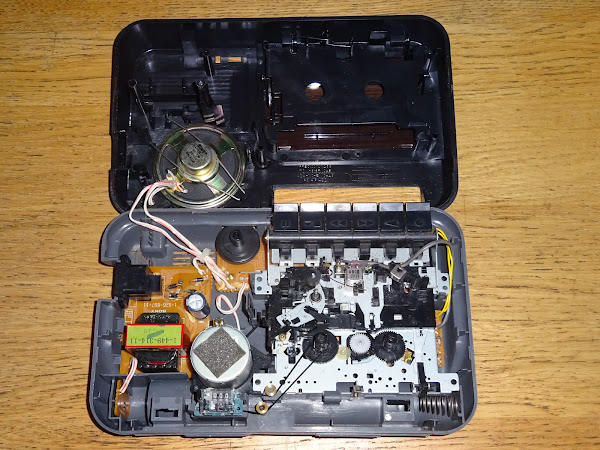
It looks like the replacement TCM-919 has screws around the side rather than those clips, so I might have a look for one of those. But I still prefer the styling of these.
Now I had it open, I thought it was worth checking what voltage the mains power supply was putting out.
It is a very simple transformer / bridge rectifier / capacitor circuit.

Measuring that shows it is outputting about 8.4V, which dropped to about 7.6V when playing.
Given that, I think I could just go for the easiest option and wire two 18650s holders directly in place of the four C cells. That would give a similar voltage range to the one it is already getting from the mains power supply.
The positive side of the battery connection is on a PCB on the side, so I soldered the red wire to the back of that.

The negative side is the usual battery spring.

The spring wire continues all the way to the main PCB. So I just soldered onto that at a convenient point. (bottom left)

You can see the LA4162 IC in the centre. No Sony branding on the IC itself? No branding of any kind?

This should give me a nice convenient way of powering one of these drives, and should last for ages. I was going to use hot glue or foam pads, but they seem to fit in place quite nicely, keeping the mods minimal and easily reversible.

Two of those recovered Samsung 18650 will do nicely. They were effectively free, recovered from an old laptop battery. Ideally you would use ones with the built in protection chips. You should probably add one of those small boards with DW01 protection chips on. I didn't have any to hand, but should probably get some.

Whilst I had the unit apart, I thought I would do the usual maintenance, clean all the grot from the mechanism and add a little white lithium grease to the moving plastic parts.

Belt up
I bought a belt kit a while ago, but have never had a reason to fit it, they have all just worked fine.
I thought since I had this one apart, I would swap them out, see if it made a noticeable difference.

There are three belts, the smallest goes under the flywheel.

The largest goes from the top of that to the motor

There is a third thin belt that drives the tape counter.

With the new belts and 18650 based power supply, I went through the tape speed test again.

3.002 KHz, I'll take that.

That was about half volume. No clipping at the top, 7.5V.

Testing
Let's run this through a few tests, this is ideal to test out the new Minstrel 2 and 3 kits.

I'll start with a Minstrel 3, and 3D Monster Maze.
Carefully following the instructions on the back of the case.

Nice loading bars.

There were several sections where the tape is clearly worn out and the signal dropped to almost nothing. I tried both sides of the tape, but the B side was worse. No 3D Monster Maze for me today unfortunately.
Most of the other things I tried did load.

Paul Farrow's games are good tests as they have a checksum test before launching the game.
As does Psion's Flight Simulator.

Of course, you can use a real ZX81 if you have one of those.

I just had a new Spectrum cassette turn up, so I'll give that a go as well.

The Spectrum has nicer loading screens.

Ooh.. Nasty!

That has all worked out quite nicely. I was pleased to find a better solution to those fiddly C cell adapters.

The TCM-818 was clearly built to a price. I was a little disappointed to find a magnet erase head and the case being held together with clips, but I guess they spent the money on a decent cassette mechanism. Neither but neither of those caused me any problems over the years, these have been solid and reliable cassette recorders, and I hope they will continue to be for many years to come.
Advertisements
As I announced last week, I have reopened my Tindie store and have new batches of Minstrel 2 and 3 kits, for ZX81 case or standalone with keyboard, and ZXpand microSD card interface.
From there I can ship worldwide.
I will slowly be moving things over there from my SellMyRetro store, so if there is anything that you want, let me know and I'll add it.

More info can be found here:
Patreon
You can support me via Patreon, and get access to advance previews of posts like this and behind the scenes updates. These are often in more detail than I can fit in here, and some of these posts contain bits from several Patreon posts. This also includes access to my Patreon only Discord server for even more regular updates.


